
New paragraph
Our Services
Recovering Technology Programs. Restoring Delivery Confidence
Most IT projects don't fail suddenly. They drift — decisions start stalling, stakeholder confidence erodes, vendor accountability blurs, and delivery momentum slows until the situation is serious enough to demand structured intervention.
When that point arrives, the instinct is often to push harder — more oversight, more meetings, more pressure on the team. In our experience, that instinct rarely works. What works is a structured, disciplined approach that identifies exactly what broke down, intervenes at the right points, and embeds the controls needed to make sure it does not happen again.
The Tech on Track SWITCH Methodology™ is a proprietary six-phase IT project recovery framework developed by Nadia Leung from 25 years of recovering complex projects at Accenture, Mastercard (USA), Telstra, Optus, NBN, APA Group, and AEMO. It is not a generic framework adapted from a methodology textbook. It was built from the hard-won experience of what actually causes projects to fail at enterprise scale — and what it takes to bring them back.
Does any of this sound familiar?
You may not be ready to call it a failure. But if any of these sound familiar — you need a structured response, not more of the same.
- Milestones keep slipping and no one can give you a credible recovery plan
- Your project reporting says green but your instinct says something else
- The vendor is managing the narrative and you have lost independent visibility
- The steering committee meets but nothing gets decided or resolved
- Budget contingency is being consumed faster than anticipated
- Stakeholder and Board confidence in delivery is declining
- A previous review flagged risks that have still not been resolved
- The team is under unsustainable pressure and morale is deteriorating
If you recognised yourself in any of these — the SWITCH Methodology™ was built specifically for this moment.
How the SWITCH Methodology™ is engaged
In most Tech on Track engagements, the SWITCH Methodology™ follows a SWITCH Exposure Assessment™ or SWITCH Foundation Assessment™ — where the independent assessment has confirmed that the project requires structured recovery intervention rather than incremental improvement.
This sequencing matters. Going into a recovery engagement without first understanding exactly what went wrong and why, is one of the most common reasons recovery efforts fail. The assessment provides the diagnostic foundation on which the recovery plan is built.
The SWITCH Methodology™ can also be engaged directly, without a prior assessment, when the need for recovery is already clear and time is critical.
Whichever path brings you here — assessment first or direct engagement — the outcome is the same. You move from the current situation to a stable, self-sustaining delivery position without starting from scratch.
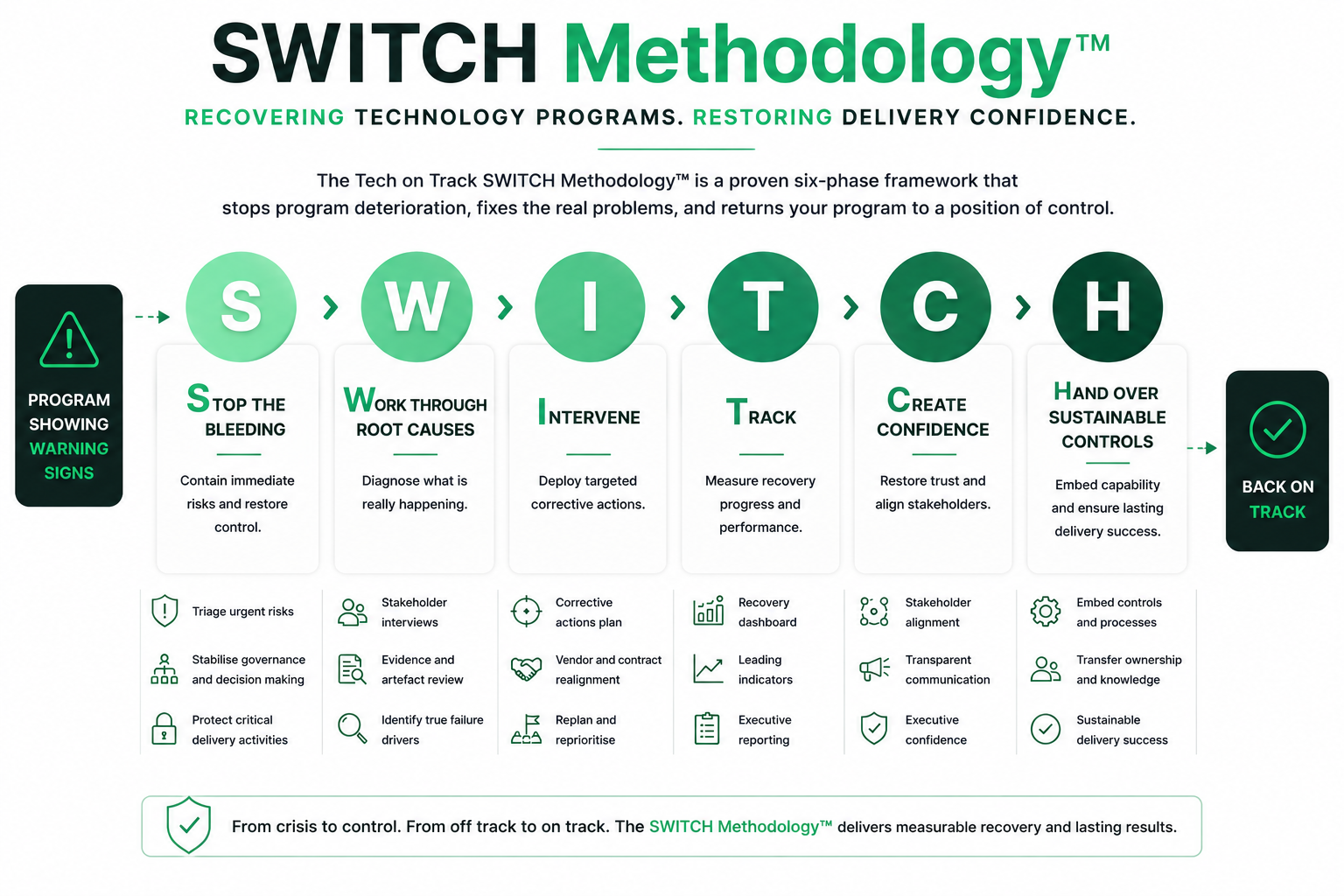
S
S — Stop the Bleeding
Contain Immediate Risks and Regain Control
When a technology project begins showing warning signs, immediate action is required to prevent further deterioration. This phase focuses on stabilising troubled technology programs, restoring governance, improving visibility and addressing critical delivery risks that threaten project success. The objective is to stop the situation from worsening and provide leadership with the clarity needed to make informed decisions.
W
W — Work Through Root Causes
Identify the Real Drivers of Project Failure
Many troubled technology programs attempt to solve symptoms rather than addressing the underlying causes of poor delivery performance. This phase investigates the governance, planning, stakeholder, vendor and organisational factors contributing to project delays, cost overruns and delivery challenges. Understanding the root causes of failure creates the foundation for successful project recovery.
I
I — Intervene
Implement Corrective Actions That Improve Delivery Outcomes
Once the root causes have been identified, targeted corrective actions are implemented to address the issues preventing successful delivery. This phase focuses on improving governance, strengthening accountability, realigning stakeholders, addressing vendor performance concerns and establishing a realistic path to project success.
T
T — Track
Track Recovery Progress and Program Performance
Technology project recovery must be visible, measurable and accountable. This phase establishes the reporting, governance and performance measures required to monitor recovery progress, validate corrective actions and provide leadership with confidence that the project is moving in the right direction. What gets measured gets managed.
C
C — Communicate Relentlessly
Restore Stakeholder Confidence Through Transparency
One of the most common signs of a troubled technology program is declining stakeholder confidence. This phase focuses on transparent communication, clear reporting and proactive stakeholder engagement to ensure decision-makers remain informed, aligned and confident in the recovery journey. Recovery is not only about delivery performance; it is also about rebuilding trust.
H
H — Hand Over Sustainable Controls
Embed Governance and Delivery Capability for Long-Term Success
The objective of project recovery is not ongoing dependency on external support. This phase focuses on embedding governance frameworks, delivery disciplines and organisational capability that enable technology programs to continue successfully after recovery activities conclude. Sustainable recovery means leaving the organisation stronger than before.